

The hippocampus and memory
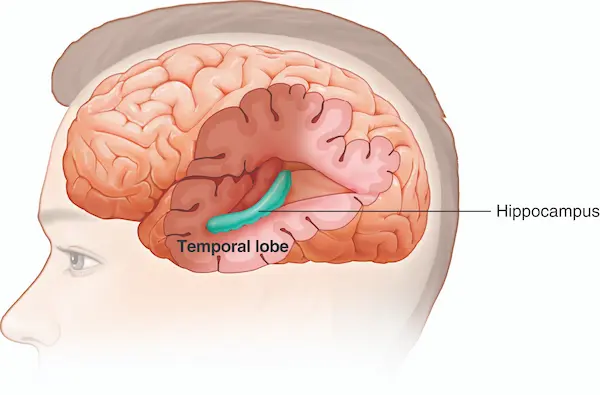
If you ask a neuroscientist which part of the brain is needed for storing and retrieving memories, they'll probably say the hippocampus. That's what I'd say. But there are some subtleties to add.
First, what type of memory are we talking about? You don't need the hippocampus to remember how to ride a bicycle. That information is stored in brain regions necessary for acquiring skills and habits, behaviors that you've performed so often that you can now carry them out automatically. We'll consider those brain areas in other tutorials and other chapters.
You probably don't need the hippocampus in order to remember a telephone number before you get the chance to type it into your phone. Working memory used to keep something in mind by actively rehearsing it appears to involve other brain regions as well. We'll examine them when we look at working memory and attention in chapter 10.
At least in humans, the kind of memories most strongly associated with the hippocampus are memories of your life events, which are called episodic memories. When I recall a Thanksgiving dinner with my family that occurred a few years ago, I am likely relying on the hippocampus for that memory retrieval. And I was also relying on the hippocampus to help store the memory at the time it occurred. When you recall what you had for breakfast yesterday, you are likely activating the hippocampus. In fact you may be reactivating some of the same hippocampal neurons that were active while you were having breakfast.
In order to appreciate the hippocampal role in episodic memory, it is helpful to learn about a breakthrough studies of a patient who was missing the hippocampus on both sides of his brain, Henry Molaison. Henry could not store or retrieve memories of most of his life events. An exception was that he could recall very old memories, such as those from his childhood. We'll want to understand why those very old memories survived his hippocampal loss.
While the hippocampus is important in episodic memory storage and retrieval, this doesn't mean that the memories are actually stored within the hippocampus. Memory storage and retrieval is widely believed to depend upon an interplay between the hippocampus and the cerebral cortex.
Take some time now to read about the case of Henry Molaison, the man without a hippocampus. It's in section 9.1.1 of Principles of ... . Then, look at what's meant by anterograde and retrograde amnesia; those terms are relevant when we talk about amnesia resulting from hippocampal damage. In the textbook, it's in section 9.1.2. Finally, read about how the hippocampus and cerebral cortex are believed to work together to store and retrieve episodic memories (9.1.3). Then we'll review with some interactive questions.
For the following questions, imagine that your hippocampus was destroyed.
1. Would you be able to keep a phone number in mind by rehearsing it in your mind?
2. Would you be able to learn to ride a bicycle?
3. Would you remember having gone out with your friends a few days ago?
Test yourself
Imagine that you experience an event this evening, say you and your friend go to a restaurant. These five steps describe what happens between sensory input during the original restaurant experience and future retrieval of the event from memory. They're shown here out of order. Assign each one a number (1 through 5), then click Check Order.
Test your knowledge: Anterograde/retrograde amnesia
1. After his brain damage, Robert can no longer form new episodic memories, so he recalls nothing that occurred since the day of his brain injury. On the other hand, he can still recall things that occurred before the brain damage. He even recalls the morning of the day he suffered the accident causing the brain trauma. The means he has:
2. Sarah cannot recall anything that occurred in the days and years before her brain trauma. But she can form new memories. In fact, her memory for things that occurred after the brain damage is perfectly normal. She has:
3. Giselle cannot form new memories after her brain damage. So recalls nothing that occurred after her brain injury. She also recalls virtually nothing that took place during the 10 or so years prior to the brain injury. But surprisingly, she can recall events that occurred many years before the injury, such as childhood memories. She has:
4. Individuals who have suffered severe hippocampal damage typically show:
Deepening your understanding of the hippocampus and memory
We've concentrated so far on the hippocampus' role in episodic memory. However, to strengthen your appreciation for the role of the hippocampus in memory and learning, you'll want to look into the following topics: place cells (9.1.6), concept neurons (9.1.7), synaptic plasticity (9.2.1 and 9.2.2) and neurogenesis (9.2.3). The relevant Principles ... chapter 9 textbook sections are shown in parentheses.
The earlier material on the hippocampus and episodic memory essentially asked, what happens to human memory when the hippocampus is removed. In contrast, the material on place cells and concept neurons is essentially asking what we can learn by recording the activity of individual hippocampal neurons as memory systems are engaged. Is there a relation between the activation of an individual neuron in the hippocampus and certain kinds of remembered information? The sections on synaptic plasticity ask how changes in the strength of neuronal connections relates to learning and memory. And the section on neurogenesis examines an exciting neuroscience discovery, that new neurons are born not only during fetal development and early childhood, but in adulthood as well. Many of these new-born neurons end up in the hippocampus, raising the intriguing question of how they may contribute to formation of new memories, and whether 'enriched environments' may enhance neurogenesis.
Another learning system in the brain centers upon the amygdala, a brain region associated with fear. Please read about Fear Conditioning (9.4.1) and then return here.
Welcome back.
As you know, the central amygdala receives signals from the lateral amygdala alerting it to the presence of an undesirable (aversive), threatening event. In some cases, an aversive stimulus may be painful, or it may be a sudden loud sound, or some other unconditioned aversive stimulus that the nervous system is wired innately to treat as aversive. We don't need to learn to be afraid of them; we're born fearing them. Other events acquire their fear-eliciting properties through learning ('conditioning'). Say, you've learned that a tone always comes on 2 seconds before a shock to the foot. The shock is an unconditioned aversive stimulus, while the tone is a conditioned aversive stimulus. You are afraid of it because conditioning has taught you that it predicts shock.
When a conditioned or unconditioned aversive event appears, the lateral amygdala sends a signal to the central amygdala. The central amygdala, in turn, sends signals that generate various aspects of our 'fear' response. For instance, the central amygdala activates the lateral hypothalamus, which in turn directs the sympathetic nervous system to elevate the heart rate. The central amygdala similarly activates other brain regions to generate other aspects of the fear response.
The animation below lets you picture yourself inside the central amygdala as it receives a fear signal and sends outputs to the brain regions that collectively generate a fear response.
Immersive animationStand inside the central amygdala
A frightening event arrives, the central nucleus is activated, and you watch its three output pathways produce temporary paralysis (freezing), elevated heart rate, and cortical arousal. Then you manipulate them yourself.
Enter the animationNotice in the animation, that before the feared event appears, the person or animal is walking around (baseline locomotion). But when the central amygdala activates the periaqueductal gray, all muscle activity stops (the muscles are temporarily paralyzed). At the same time, amygdala output to the locus coeruleus generates vigilance, a state of alertness for possible threats. EEG recordings of cortical activity indicate a state of high alertness.
Even with the background you've gained in hippocampal and amygdala-based learning and memory, there are still a few gaps in your knowledge of long-term memory, learning and the brain. Here are some topics I suggest you read about either in Principles... or elsewhere. As always, the chapter sections in Principles... are in parentheses.
- the role of the basal ganglia in behavioral automaticity and habit learning (9.3.2)
- the role of the cerebellum in learning (9.4.2)
- learning in a very simple organism -- even sea snail (aplysia) neurons are capable of neural plasticity and learning (9.4.3).